DYNAMIXEL Protocol 2.0
This chapter describes the Protocol 2.0 wire format and exactly what DXL2-C does with each part of it. The normative reference is the ROBOTIS Protocol 2.0 specification.
The bus
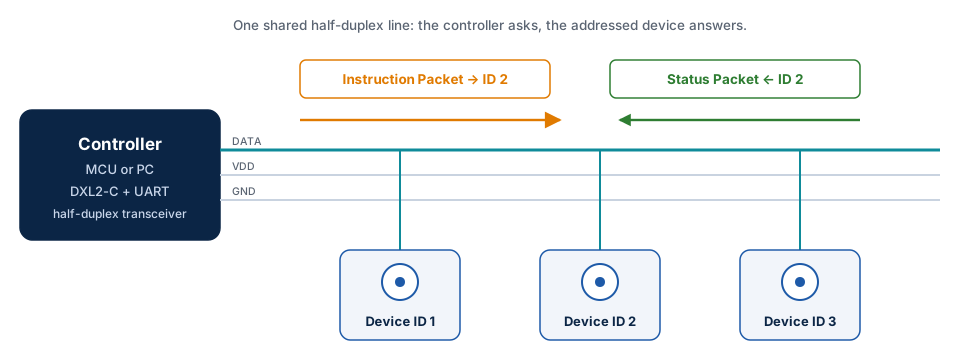
DYNAMIXEL devices share one serial line (TTL or RS-485) in a daisy chain. The line is half duplex: only one node may transmit at a time. Communication is always a request/response exchange:
- The controller sends an Instruction Packet addressed to one ID (0–252) or to the broadcast ID 254.
- The addressed device executes it and, unless the instruction was broadcast or its Status Return Level says otherwise, answers with a Status Packet after its Return Delay Time.
- The controller waits for the reply with a timeout before it sends the next request.
The UART format is 8 data bits, no parity, one stop bit; the bit rate is configured per device (57600 bit/s by default on most models, up to several Mbit/s).
Packet
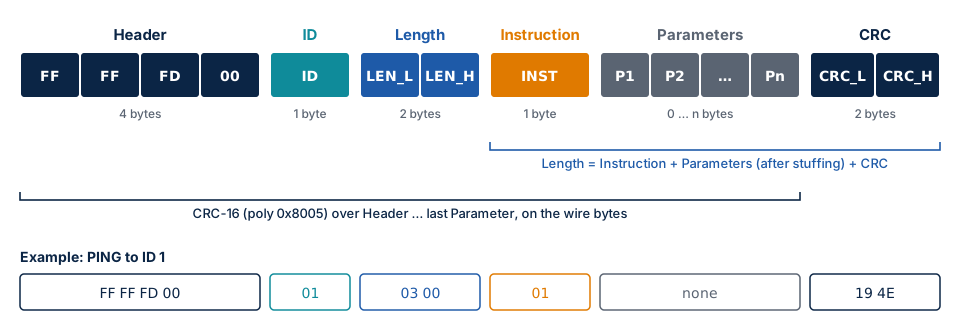
| Field | Offset | Size | Meaning |
|---|---|---|---|
| Header | 0 | 4 | Always FF FF FD 00 |
| ID | 4 | 1 | Device ID 0..252; 0xFE = broadcast (DXL2_BROADCAST_ID) |
| Length | 5 | 2 | Little endian. Counts the instruction, the stuffed parameters and the CRC, so the minimum is 3 |
| Instruction | 7 | 1 | DXL2_INST_*; 0x55 marks a Status Packet |
| Parameters | 8 | n | Instruction parameters; for a Status Packet the first byte is the error |
| CRC | 7 + Length − 2 | 2 | Little endian, over all bytes from the header up to the CRC (stuffed) |
A complete packet is therefore 7 + Length bytes long; the shortest one (no parameters)
is 10 bytes. All multi-byte values inside the parameters — addresses, lengths, register
values — are little endian too: use dxl2_get_u16/u32 and dxl2_put_u16/u32.
In struct dxl2_packet the library gives you the ID, the instruction and the
unstuffed parameters with their count. The header, Length and CRC are consumed by the
parser.
CRC-16
Polynomial 0x8005, initial value 0, not reflected, no final XOR
(the CRC-16/BUYPASS variant). It is computed over the stuffed packet. The
ROBOTIS PING reference packet FF FF FD 00 01 03 00 01 has CRC 0x4E19
(transmitted as 19 4E). The CRC is computed bit by bit without a lookup table,
which keeps the code small; its execution time depends only on the length.
Byte stuffing
So that a header never appears inside a packet, the sender inserts an extra
0xFD after every FF FF FD sequence in the instruction/parameter area, and
the receiver removes it. The Length field counts the stuffed bytes.
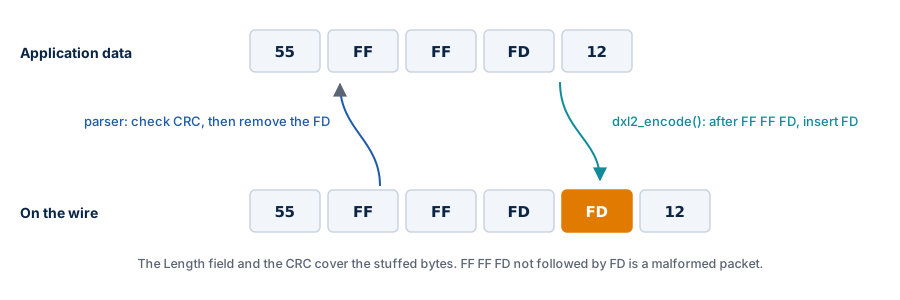
The rule applies to the whole area after the Length field — instruction and parameters — so a sequence that starts in the instruction byte is stuffed too.
dxl2_encode() stuffs while it writes. The parser checks the CRC over the
stuffed bytes first, then unstuffs. An FF FF FD that is not followed by FD
is a malformed packet (DXL2_PARSE_ERROR).
Instructions
| Value | Name | Value | Name |
|---|---|---|---|
0x01 |
PING | 0x55 |
STATUS (reply) |
0x02 |
READ | 0x82 |
SYNC_READ |
0x03 |
WRITE | 0x83 |
SYNC_WRITE |
0x04 |
REG_WRITE | 0x8A |
FAST_SYNC_READ |
0x05 |
ACTION | 0x92 |
BULK_READ |
0x06 |
FACTORY_RESET | 0x93 |
BULK_WRITE |
0x08 |
REBOOT | 0x9A |
FAST_BULK_READ |
0x10 |
CLEAR | ||
0x20 |
BACKUP |
Parameter layouts of the common instructions:
| Instruction | Parameters |
|---|---|
| PING | none; reply data: model number (2), firmware version (1) |
| READ | address (2), length (2); reply data: length bytes |
| WRITE / REG_WRITE | address (2), data (n) |
| SYNC_READ | address (2), length (2), ID list |
| SYNC_WRITE | address (2), length (2), then per device: ID (1) + data (length) |
The library encodes and decodes every instruction the same way; interpreting the parameters (the Control Table) is up to the application.
Status Packet error byte
| Value | DXL2_ERR_* |
Meaning |
|---|---|---|
0x00 |
NONE |
OK |
0x01 |
RESULT_FAIL |
Instruction could not be processed |
0x02 |
INSTRUCTION |
Undefined instruction, or ACTION without REG_WRITE |
0x03 |
CRC |
CRC mismatch |
0x04 |
DATA_RANGE |
Value outside the register range |
0x05 |
DATA_LENGTH |
Data shorter than the register |
0x06 |
DATA_LIMIT |
Value outside the configured limit |
0x07 |
ACCESS |
Read-only / write-only / torque-locked register |
| bit 7 | ALERT_BIT |
Device has a hardware error (Hardware Error Status) |
Parser behavior
dxl2_parser_feed() takes one byte at a time:
- Bytes before a complete
FF FF FD 00header are discarded (sliding window), so the parser resynchronizes after noise or a lost byte. - After 7 bytes it reads Length. A Length below 3 or one that would exceed
DXL2_MAX_PACKET_SIZE(256 bytes on the wire by default, seeinc/dxl2_config.h) is rejected at once. - When the whole packet is in, it checks the CRC, then unstuffs into
struct dxl2_packetand returns1. - Any error returns
DXL2_PARSE_ERRORand resets the parser; keep feeding bytes, the next packet is found normally.
The bytes of a rejected packet are discarded, including any that follow its header. If a byte was lost so that the Length field counts into the next packet, that packet is rejected too and the parser resynchronizes on the one after it. A controller should therefore treat a missing reply as a timeout and retry, as the ROBOTIS DynamixelSDK does.
The output packet is not touched while a packet is incomplete or when its CRC
is wrong. After any error its contents are undefined: use it only when
dxl2_parser_feed() returns 1.
Reference packets (from the specification, used in the tests)
| Packet | Bytes |
|---|---|
| PING to ID 1 | FF FF FD 00 01 03 00 01 19 4E |
| Status of ID 1 (model 1030, firmware 38) | FF FF FD 00 01 07 00 55 00 06 04 26 65 5D |