How It Works
This chapter explains the internal structure of DXL2-C: its layers, how a byte becomes a packet and a packet becomes bytes, how the parser recovers from errors, and the rules for memory, errors and concurrency that follow from the design.
Layers
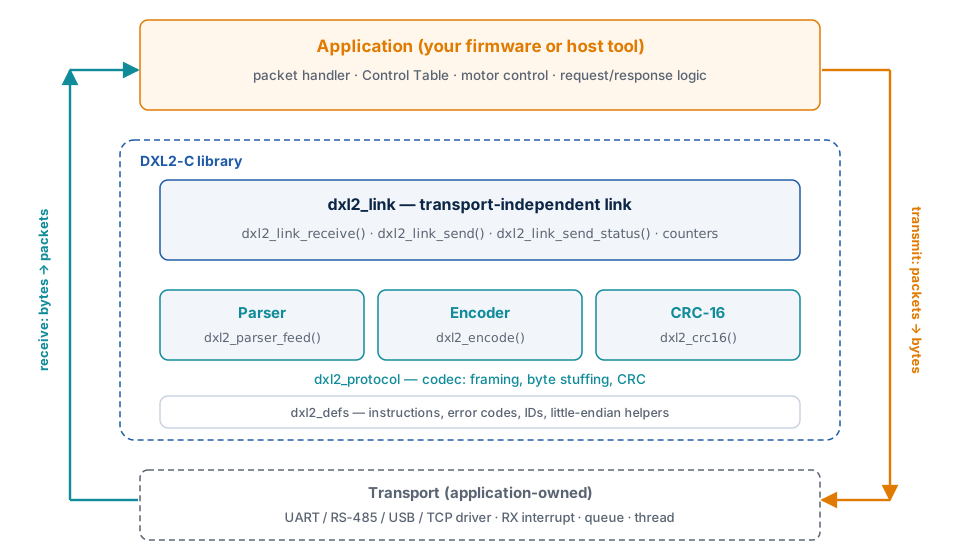
The library has three layers. Each one depends only on the layers below it.
| Layer | Header | Responsibility |
|---|---|---|
| Definitions | dxl2_defs.h |
Instruction and error values from the specification, broadcast ID, little-endian helpers. No state, no functions with side effects. |
| Codec | dxl2_protocol.h |
CRC-16, the incremental stream parser and the encoder. Pure functions over caller-owned buffers. |
| Link | dxl2_link.h |
Glue between the codec and a transport: owns a parser, dispatches packets to a handler, sends packets through a write function, counts good and bad packets. |
dxl2.h includes all of them, together with the build-time configuration in
dxl2_config.h. Applications normally include only dxl2.h.
You can use the codec without the link — for example in a tool that parses a log file, or in firmware that already has its own message dispatcher. The link is a thin convenience layer (about 100 lines) on top of the codec.
Data flow
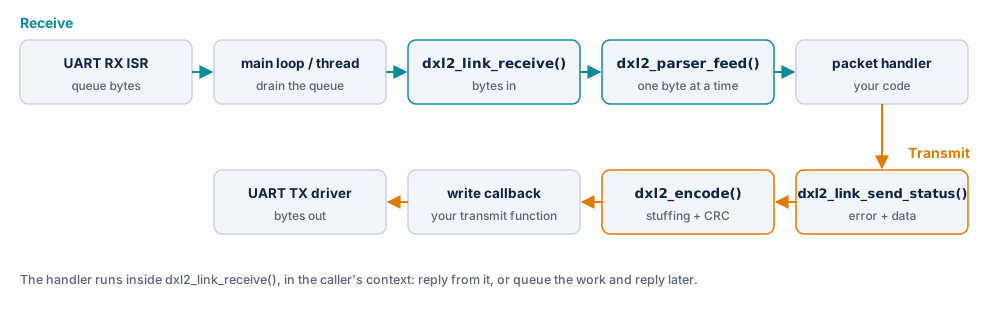
Receive path. Your transport delivers bytes — typically a UART interrupt puts them in
a queue, and a main loop or thread takes them out. You pass them to
dxl2_link_receive() in chunks of any size. The link feeds them one at a time to
dxl2_parser_feed(). Whenever the parser completes a valid packet, the link increments
its rx_packets counter and calls your packet handler with a pointer to the decoded
packet. Rejected packets increment invalid_packets and are otherwise ignored.
Transmit path. To send, you call dxl2_link_send() (any instruction) or
dxl2_link_send_status() (a Status Packet). The link encodes the packet into a buffer on
its own stack with dxl2_encode(), which adds the header, Length, byte stuffing and CRC,
and then passes the complete packet to your write function in one call.
The handler runs inside dxl2_link_receive(), in the context that called it. It may send
replies on the same link directly: transmitting does not touch the parser.
The parser
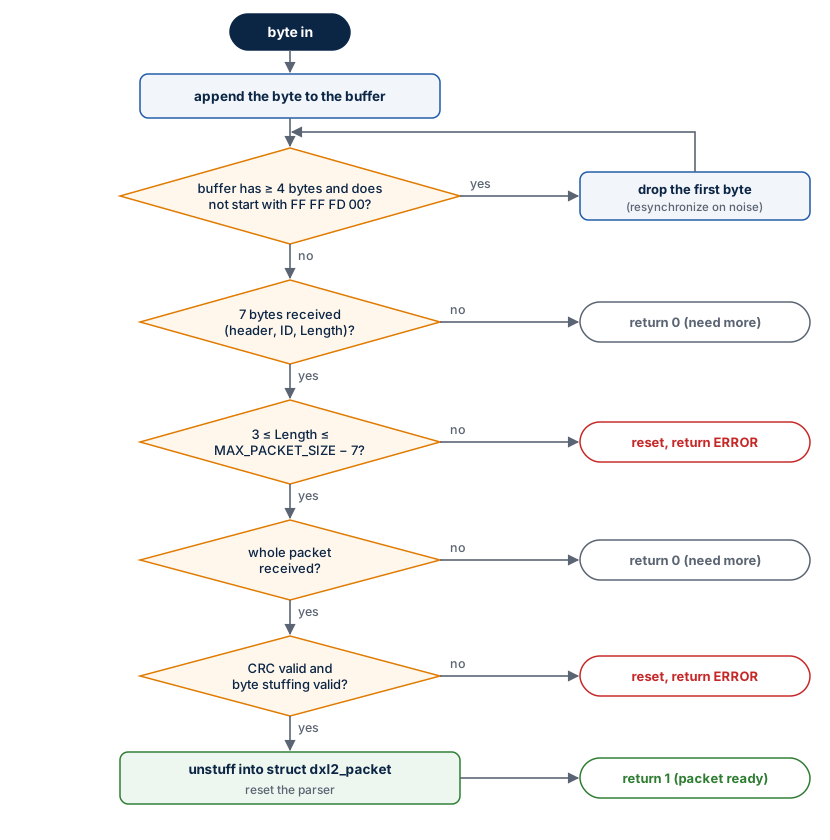
dxl2_parser_feed() consumes exactly one byte per call and returns 1 (packet ready),
0 (need more bytes) or DXL2_PARSE_ERROR. Internally it keeps the bytes of the packet
in progress in struct dxl2_parser:
- Append. The new byte is stored at the end of the buffer.
- Synchronize. While the buffer holds at least four bytes that are not the header
FF FF FD 00, the first byte is dropped. This sliding window discards noise and partial packets and lines the buffer up with the next header. - Check the Length. Once seven bytes are present (header, ID, Length), the Length
field is checked: it must be at least 3 (instruction and CRC) and the whole packet must
fit in
DXL2_MAX_PACKET_SIZE. A bad Length is rejected at once, without waiting for bytes that may never come. - Wait. Until
7 + Lengthbytes are present, the parser returns0. - Validate and decode. The CRC is checked over the stuffed bytes, exactly as they
were sent. Then byte stuffing is removed while the instruction and parameters are
copied into
struct dxl2_packet. A header sequence without its stuffing byte is a malformed packet. - Reset. After a packet — valid or not — the parser buffer is emptied and the next byte starts a new search.
The cost per byte is constant except for the synchronization step, which moves at most
DXL2_MAX_PACKET_SIZE bytes. There is no recursion and no data-dependent loop without a
fixed bound, so the worst-case execution time is easy to bound.
Recovery after errors
The bytes of a rejected packet are discarded. If a lost byte makes the Length field reach into the next packet, that packet is rejected too, and the parser locks onto the one after it. Controllers should treat a missing reply as a timeout and retry.
The encoder
dxl2_encode() writes the header and ID, then copies the instruction and parameters into
the output buffer. After every byte it checks whether the last three bytes written are
FF FF FD; if so, it inserts an extra FD. It then fills in the Length field — which
counts the stuffed bytes — and appends the CRC computed over everything before it.
The output capacity is checked before every byte is written, so an undersized buffer
returns DXL2_PARSE_ERROR instead of overflowing. The worst case for stuffing is one
extra byte per three parameter bytes; with DXL2_MAX_PACKET_SIZE as the capacity, every
packet that the parser accepts can also be encoded.
Memory model
All state lives in two structures that you allocate — statically, on a stack or inside your own objects:
| Structure | Contents | Size with the default configuration |
|---|---|---|
struct dxl2_parser |
bytes of the packet in progress, their count | 256 bytes + size_t |
struct dxl2_packet |
ID, instruction, parameter count, unstuffed parameters | 250 bytes |
struct dxl2_link |
configuration, one parser, the last packet, two counters | ≈ 550 bytes on a 32-bit MCU |
The library has no global variables except one read-only table (the header bytes), never
calls malloc(), and allocates only fixed-size buffers on the stack: one packet buffer in
dxl2_link_send() and one parameter buffer in dxl2_link_send_status(). The measured
stack usage per function is listed in Configuration.
Because nothing is shared, you can have as many links as you have buses, each with its own configuration.
Error handling
Every function reports errors through its return value; nothing is printed, logged or asserted.
| Situation | Result |
|---|---|
A NULL pointer or inconsistent length passed to a function |
DXL2_PARSE_ERROR (or 0 for dxl2_crc16() and the counters); nothing is written |
| A packet with a bad Length, CRC or byte stuffing | dxl2_parser_feed() returns DXL2_PARSE_ERROR; the link counts it in invalid_packets |
| A packet that does not fit in the output buffer | dxl2_encode() and dxl2_link_send*() return DXL2_PARSE_ERROR |
| The write function fails | dxl2_link_send*() return the write function's own (negative) value |
| A corrupted parser structure (for example, never initialized) | dxl2_parser_feed() resets it and returns DXL2_PARSE_ERROR instead of writing out of bounds |
Protocol-level errors that a device reports — an unknown instruction, an address out of
range — are not library errors. Your handler sends them back as the error byte of a
Status Packet (DXL2_ERR_*).
Threading and reentrancy
The library contains no locks, by design: the right primitive depends on your system, and a hidden mutex would make the library unusable in interrupt-only firmware.
- Codec functions are reentrant. They only touch the buffers you pass in, so they can be called from any context, concurrently, as long as each call has its own buffers.
- A link is not thread-safe. Call
dxl2_link_receive()for a given link from one context only. Do not call it from an interrupt handler: the packet handler runs inside it and usually transmits. - Sending from several contexts at once (for example an RX thread replying and an
application thread sending commands) needs a mutex around your write function, or
around the
dxl2_link_send*()calls. - The packet handler receives a pointer into the link. The data is valid only until the handler returns; copy what you need to keep.
Design decisions
| Decision | Reason |
|---|---|
| One byte per parser call | Works with any transport chunking, including single-byte interrupts, with no internal buffering policy to configure. |
| CRC checked before unstuffing | The CRC is defined over the bytes on the wire; checking first rejects corrupted packets before any data is copied. |
| Fixed-size buffers from one macro | Memory use is known at build time and can be reviewed; one macro scales everything consistently. |
| Callbacks for I/O | The library never needs to know about drivers or operating systems, and it is trivial to test with mocks. |
int status codes |
Lets an existing driver write() function be used as the write callback without a wrapper; recorded as MISRA deviation DEV-01. |