Integration Guide
Stepper-C does not touch hardware. An integration has four parts:
- PWM: a timer with one compare channel per leg, loaded by
pwm_write(). - Measurement: ADC conversions of the two phase currents and the bus voltage,
synchronized to the PWM, passed to
sstep_fast_loop()as raw counts. - Fast loop interrupt: at the end of each conversion sequence, call
sstep_fast_loop(). - Slow loop: call
sstep_slow_loop()and the commands from one task or the main loop atslow_loop_hz.
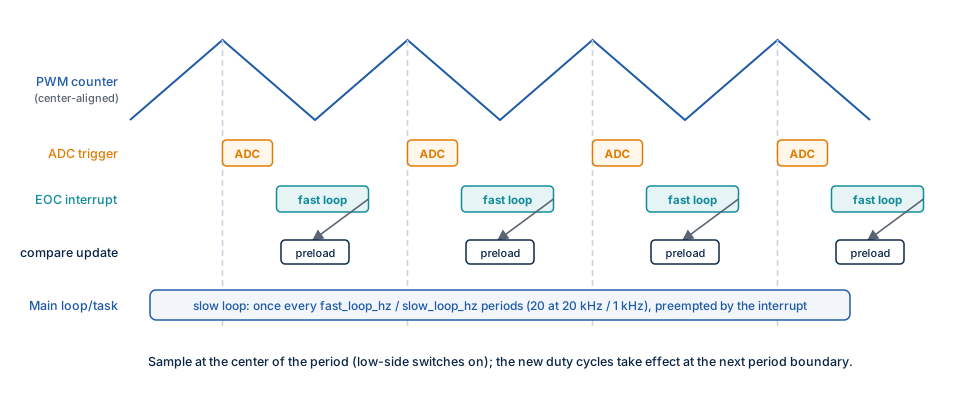
PWM
- Use center-aligned PWM with the period
pwm_period_ticks; one compare value per leg, in the order of the topology: full bridge[A+ A− B+ B−], shared leg[U V W]. A compare value ofpwm_period_ticksmeans the high-side switch is on for the whole period. - Load the compare values with preload (shadow registers) so that
pwm_write()takes effect at the next period boundary, not in the middle of a period. - Dead time is inserted by the timer or the gate driver; the library does not compensate it in this version.
output_enable(false)must put every leg in high impedance (for example the timer's main output enable bit and the gate drivers' enable pins), not only set 50 % duty.
Current and voltage measurement
- Trigger the ADC from the PWM timer at the center of the period, where the low-side switches conduct and the switching noise is furthest away; with low-side shunts this is the only point where the current is visible.
- Convert phase A, phase B and the bus voltage in one sequence, and call
sstep_fast_loop()from its end-of-conversion interrupt. - In the shared-leg topology the two measured currents are the phase currents A and B; the shared leg carries their sum.
- Measure
adc_i_zerowith the outputs off after power-up; the library uses the value from the configuration, so re-initialize with the measured value if it differs from the default.
Timing
| Item | Requirement |
|---|---|
fast_loop_hz |
The real rate of the end-of-conversion interrupt; usually the PWM frequency or a fraction of it (every second period at 40 kHz PWM) |
slow_loop_hz |
The real rate of sstep_slow_loop(); fast_loop_hz must be a multiple of it |
| Jitter of the slow loop | Tolerated: the fast loop holds the angle if the slow loop is late, and catches up with the next setpoint |
| Priority | The fast-loop interrupt preempts the slow-loop context, never the other way round |
| Execution time of the fast loop | Must end well before the next conversion; measure it on your MCU (toggle a pin or read the cycle counter) |
The library measures nothing about time: if the configured rates do not match the real ones, the velocities, the accelerations and the hold delay scale accordingly.
Bare metal
int main(void)
{
    board_init(); /* clocks, PWM timer, ADC triggered by the timer, interrupts */
    if ((sstep_init(&motor, &motor_config) != SSTEP_OK) || (sstep_enable(&motor) != SSTEP_OK))
    {
        for (;;)
        {
        }
    }
    for (;;)
    {
        if (board_tick_1ms()) /* set by SysTick or a timer */
        {
            (void)sstep_slow_loop(&motor);
            /* commands and the application's state machine here */
        }
    }
}
RTOS
Run the slow loop in a periodic task with a fixed period (not a delay after the work), and call every command from that task, or from another task through a queue:
#include "FreeRTOS.h"
#include "task.h"

static void motor_task(void* arg)
{
    TickType_t wake = xTaskGetTickCount();
    (void)arg;
    for (;;)
    {
        vTaskDelayUntil(&wake, pdMS_TO_TICKS(1));
        (void)sstep_slow_loop(&motor);
        /* take commands from a queue and call sstep_move_to() etc. here */
    }
}
The fast loop stays in the ADC interrupt; give it a priority above the RTOS kernel's interrupt priority limit only if it calls no RTOS function (the library calls none; check your callbacks).
Adding the library to a CMake build
set(SSTEP_MATH_BACKEND FLOAT)                         # MCU with FPU; default FIXED
include(path/to/Stepper-C/sstep.cmake)
target_link_libraries(app PRIVATE sstep)
target_link_libraries(sstep PUBLIC zephyr_interface)  # Zephyr applications only
The backend and the other build-time options are compile definitions of the sstep
target, so the application sees the same values as the library.
Without CMake: compile src/*.c, add the repository root and inc/ to the include
path, and pass the same -DSSTEP_CFG_… definitions to the library and the application.
Bring-up checklist
- Outputs off: read the ADC and check
adc_i_zeroand the bus voltage reading against a multimeter (sstep_get_status()showsvbus_mvafter a fast loop). - Polarity: start with
drive_mode = SSTEP_DRIVE_VOLTAGEand a smalli_run_ma; aftersstep_enable(), the measured current of phase A must be positive and close to the reference. If it is negative, negateadc_i_span. - Current loop: switch to
SSTEP_DRIVE_CURRENTwith a low run current; look at the phase current with a current probe or the status: it must settle ati_run_ma. - Motion: run slowly (
sstep_run()with a few hundred microsteps/s), then raise the speed and the acceleration to the application's values. - Protection: check the trips with a lowered
i_trip_maandvbus_max_mv, and the external fault input withsstep_report_fault(). - Stall detection (optional): enable it with the example values, log
stall_level_pct,emf_d_mvandload_angle_cdegthrough every operating point (enable, hold, the fastest move, the heaviest load), then block the shaft by hand at speed and at standstill to seeSSTEP_FAULT_STALL(choosing the parameters).