Introduction
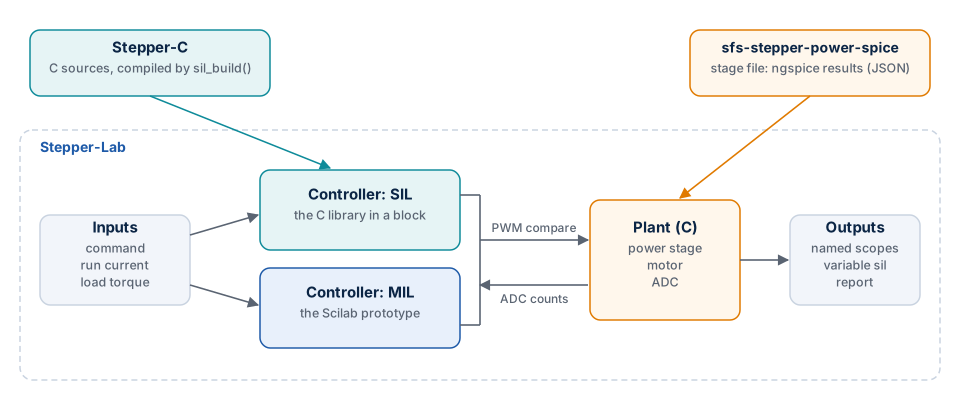
Stepper-Lab is a Scilab/Xcos model of a two-phase hybrid stepper motor with its power stage and
current measurement. It lets you run the control code of
Stepper-C against that model on a PC, drive it
with any signal, and read the results, before the code reaches hardware.
What it does and does not do
| It does |
Why |
| Runs the real C code of Stepper-C inside an Xcos diagram (software in the loop, SIL) |
The code under test is the code that ships: ADC counts in, PWM compare values out |
| Runs a Scilab prototype of the same controller in the same layout (model in the loop, MIL) |
An algorithm can be changed and studied without compiling it |
| Accepts any Xcos source as motion command, run current or load torque |
Step, sine, ramp and your own signals use the same three inputs |
| Models the power stage as averaged or switching, with results from ngspice |
The fast model is enough for most runs; the slow one shows ripple and dead time |
| Checks itself: tests against theory, against a Python twin, and between MIL and SIL |
Each model is checked by something other than itself |
| It does not |
Why |
| Replace measurements on your motor |
Back-EMF constant, friction and detent torque of the example motor are derived or assumed; Configuration marks which |
| Control a real motor |
It is a simulation; the firmware that uses Stepper-C is a separate matter |
| Include Stepper-C |
The library has its own repository; you select its folder |
| Run ngspice |
The window only selects a stage file that sfs-stepper-power-spice has exported |
| Model temperature, saturation or the motor beyond its two-phase equations |
The equations are in Motor and Control Model |
Who it is for
Embedded and control engineers who work with stepper motors and want to see what a controller
does before the first power-up. No Scilab knowledge is needed for the first runs: the
Lab window holds the choices, and the scenarios are ready to run.
| Project |
Role here |
| Stepper-C |
The control library under test. Its sources are compiled into the SIL blocks |
| sfs-stepper-power-spice |
ngspice models of the power stage. Its export is the stage file: leg resistance, diode voltage, effective dead time and the leg voltage error table |
Rule of this project: the Scilab model follows the algorithm of the library. A change in
Stepper-C is ported to the prototype and to the Python twin in the same step, and the tests show
whether they still agree.
Key properties
| Property |
Value |
| Tool |
Scilab 2027 with Xcos; a C compiler for the plant and the library |
| Example motor |
17HS19-2004S1: 1.60 Ω, 3.0 mH, 2.0 A, 200 steps per revolution |
| Example board |
B-G431B-ESC1: 24 V, 20 kHz PWM, three legs with a shared leg |
| Controllers |
SIL (C, FIXED or FLOAT backend), MIL (Scilab) |
| Stepper-C version used for the results |
main at commit 3ef0f7e, which reports itself as 1.1.0 and has stall detection fixes made after the tag v1.1.0 |
| Tests |
433 checks, 0 failures on the final full run (Verification) |
| Platform of all results |
Windows 10 with Scilab 2027.0.0 |
| License |
Apache License 2.0 |
Terminology
| Term |
Meaning |
| SIL |
Software in the loop: the compiled C library runs against the model |
| MIL |
Model in the loop: the Scilab prototype of the controller runs against the same model |
| Plant |
Power stage, motor and current measurement: everything the controller acts on |
| Prototype |
The Scilab implementation of the controller (model/ctrl_period.sci and the functions it calls) |
| Python twin |
Independent Python implementation of parts of the model, in tools/; it checks the Scilab results |
| Stage file |
JSON export of sfs-stepper-power-spice with the measured values of a power stage |
| Scenario |
A ready experiment of the window: context lines and source blocks |
| Backend |
The numeric form of Stepper-C: FIXED (Q15) or FLOAT |
| Fast loop, slow loop |
The two periods of Stepper-C: 20 kHz current control, 1 kHz motion |
| Load angle |
Electrical angle between the commanded field and the rotor; beyond 90° the rotor is past its pull-out point |
Conventions
- Units are SI unless stated. Positions are in microsteps, with 3200 microsteps per revolution at
16 microsteps per full step.
- Functions are written
sil_report(), and files by their path from the repository root.
- The current vector is
iA = I cos(phi), iB = I sin(phi), and the rotor settles at
p theta = phi. Increasing phi turns the rotor forward. Stepper-C uses the same convention.