MIL and SIL
Both modes run the same plant in the same diagram layout. They differ only in the controller block, so a difference in the results points at the controller.
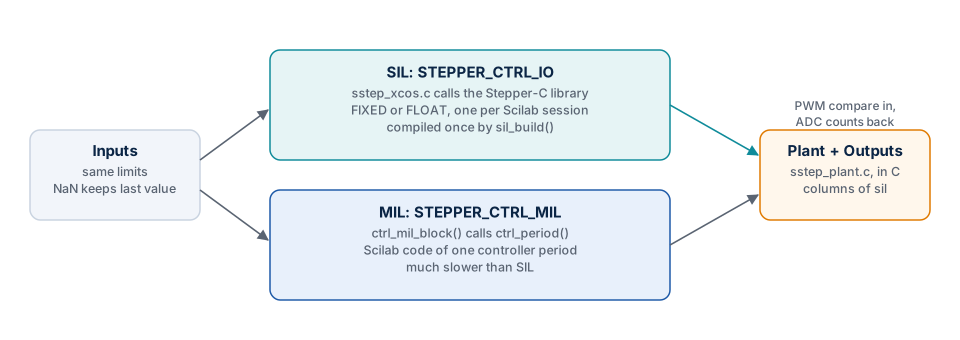
What runs in each
| SIL | MIL | |
|---|---|---|
| Block | STEPPER_CTRL_IO |
STEPPER_CTRL_MIL |
| Controller | The Stepper-C library, called by sil/c/sstep_xcos.c |
ctrl_mil_block(), which calls ctrl_period() |
| Numeric form | Q15 or float, as on the MCU | Scilab doubles, with the integer motion generator of the library |
| Plant | sil/c/sstep_plant.c |
The same |
| Input limits | sstep_xcos.c |
ctrl_mil_limit(), the same limits |
| Speed | Used for everyday runs | 15 s per simulated second on a 0.15 s run |
| Use it to | Test the code that ships | Study or change the algorithm without compiling it |
The compiled library is needed in both modes, because the plant and the monitor are C blocks in MIL too.
lab_run() and Open in Xcos link it by themselves.
Backends
Stepper-C has two numeric backends. sil_build(backend) compiles the chosen one into
sil/build/fixed or sil/build/float, once, and again when a source file changes.
| Backend | Numbers | For |
|---|---|---|
FIXED |
Q15 | MCUs without an FPU |
FLOAT |
Single precision | MCUs with an FPU |
A Scilab session links one backend. To change it, select the other one in the window and restart
Scilab. tests/run_all.sce does this by starting a second Scilab process for FLOAT.
How close they are
Tests M01 and S01 to S06 compare the modes sample by sample. These are the limits they enforce and the values measured on the final run:
| Comparison | Limit | Measured |
|---|---|---|
| MIL against SIL, current step, phase currents | 5 mA | 1.02 mA |
| MIL against SIL, move of 640 microsteps, phase currents | 5 mA | 1.28 mA |
| MIL against SIL, commanded position | 1e-6 microsteps | 0 |
| MIL against SIL, load step above pull-out | Same fault within 1 ms | OVERCURRENT and STALL at 204.9 ms in both |
After the rotor slips, the ADC quantization is amplified and the samples diverge, so a comparison of samples after a pull-out means little. The stall tests compare the fault and its time there.
Compare MIL / SIL shows this for any scenario, and reports differences only up to the first fault.
From a script:
rs = lab_run("SIL", 1);
rm = lab_run("MIL", 1);
c = lab_compare_data(rs, rm);
mprintf("%s\n", c.panels(1).title);
A configuration the library refuses
Stepper-C checks its configuration in sstep_init().
- In SIL the simulation stops with the message of the library.
- In MIL the block asks the library the same question at the start. If the answer is no, or if
the configuration asks for voltage drive (
ctl.drive = 1), which the prototype does not have, the outputs stay off, the state is 3, the fault flags are 16, and the reason is printed.lab_run()raises the reason as an error, so the window shows it. In Xcos no dialog appears and the run reachesT_end, because an error raised in this kind of block at its start ends Scilab 2027.
The stepper_sil diagram
xcos/stepper_sil.zcos, opened by start_sil.sce, is the first SIL diagram of the project and is
kept as it was. It has a flat layout, and its input is the command table.
| Context variable | Meaning | Example |
|---|---|---|
cmds |
Commands [t kind value]: 1 MOVE to, 2 RUN, 3 STOP |
[0 2 12800; 0.15 2 -12800] |
loads |
Load torque steps [t TL] |
[0 0; 0.15 0.25] |
brd.topology |
"shared" or "full" |
"full" |
brd.stage |
"avg" or "switching" |
"switching" |
mp, ctl |
Motion and control settings | mp.v_max = 25600 |
locked |
1: rotor locked | 1 |
T_end |
Simulated time, s | 1.0 |
Its results have the first 19 columns of sil.values.