ISO 15765-2 (ISO-TP)
This chapter describes the ISO 15765-2 wire format for classical CAN with normal addressing and exactly what ISOTP-C does with each part of it. The normative reference is the standard; ISOTP-C includes the 32-bit message length introduced by the 2016 edition.
The bus
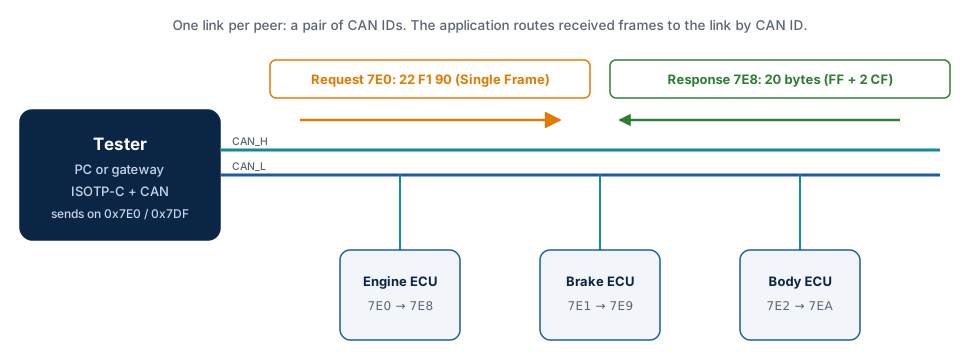
ISO-TP runs on top of CAN. Each direction between two nodes uses its own CAN ID — in
diagnostics, for example, the tester sends to an ECU on 0x7E0 and the ECU answers on
0x7E8 — and a functional ID (0x7DF) addresses all ECUs at once. One ISOTP-C link is one
such pair of IDs: it sends with tx_id, and the application gives it the frames of the
peer's ID. Both directions of a link work at the same time (full duplex).
Frames
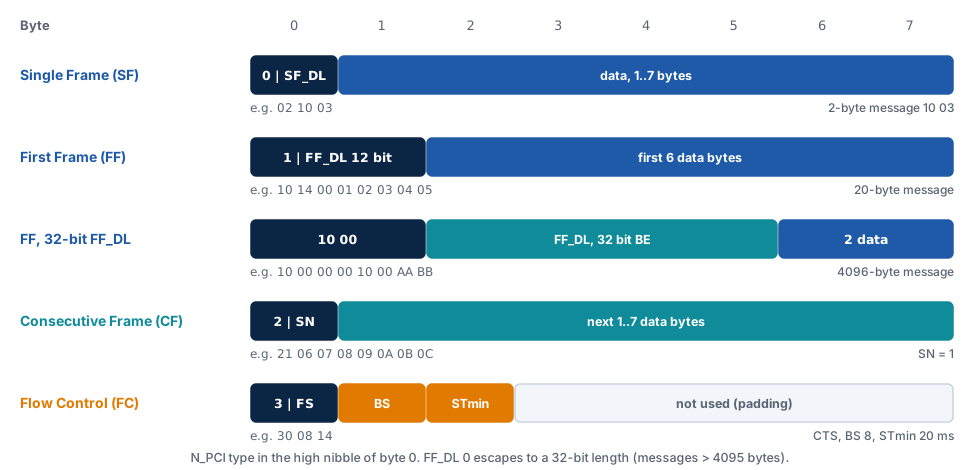
The first byte, or the first two bytes, of every frame are the protocol control information (N_PCI). Its high nibble is the frame type:
| Type | Byte 0 | Further N_PCI | Data | Use |
|---|---|---|---|---|
| Single Frame (SF) | 0 | SF_DL |
— | 1..7 bytes | A whole message of up to 7 bytes |
| First Frame (FF) | 1 | FF_DL bits 11..8 |
byte 1: FF_DL bits 7..0 | 6 bytes | Start of a message of 8..4095 bytes |
| First Frame, escape | 10 |
byte 1 00, bytes 2..5: FF_DL, 32 bit, big-endian |
2 bytes | Start of a message of more than 4095 bytes |
| Consecutive Frame (CF) | 2 | SN |
— | 1..7 bytes | Next part of the message |
| Flow Control (FC) | 3 | FS |
byte 1: BS, byte 2: STmin | — | The receiver's answer to an FF and after every block |
A First Frame is always 8 bytes long. The last Consecutive Frame carries the remaining bytes; with padding, the rest of the frame is filled with the padding byte.
Flow status, block size and separation time
| Field | Values | Meaning |
|---|---|---|
| FS | 0 CTS, 1 WAIT, 2 OVFLW |
Continue to send / wait for the next FC / message too long for the receiver |
| BS | 0 … 255 |
Consecutive Frames the sender may send before the next FC; 0: all |
| STmin | 00 … 7F |
Minimum time between two Consecutive Frames, 0..127 ms |
| STmin | F1 … F9 |
100..900 µs |
| STmin | other values | Reserved; a sender treats them as 7F (127 ms) |
isotp_st_min_encode() rounds a requested time up to the next value that can be encoded,
so the sender never goes faster than asked; isotp_st_min_decode() maps the reserved
values to 127 ms.
Timers and N_Result
| Timer | Side | Runs from … to … | Default | On expiry |
|---|---|---|---|---|
| N_Bs | Sender | FF or last CF of a block written → FC received | 1000 ms | ISOTP_N_TIMEOUT_BS |
| N_Cr | Receiver | FC written or CF received → next CF received | 1000 ms | ISOTP_N_TIMEOUT_CR |
ISO 15765-2 also defines N_As/N_Ar (time for the CAN driver to send a frame) and the
performance times N_Br/N_Cs. ISOTP-C writes frames synchronously through your write
function, so it does not time them: ISOTP_N_TIMEOUT_A is never produced.
| N_Result | Reported when |
|---|---|
ISOTP_N_OK |
The message was sent or received completely |
ISOTP_N_TIMEOUT_BS |
No Flow Control frame within N_Bs |
ISOTP_N_TIMEOUT_CR |
No Consecutive Frame within N_Cr |
ISOTP_N_WRONG_SN |
A Consecutive Frame with an unexpected sequence number |
ISOTP_N_INVALID_FS |
A Flow Control frame with an unknown flow status |
ISOTP_N_UNEXP_PDU |
A Single or First Frame interrupted a reception |
ISOTP_N_WFT_OVRN |
More than N_WFTmax Flow Control frames with WAIT in a row |
ISOTP_N_BUFFER_OVFLW |
Sender: the receiver answered OVFLW. Receiver: the announced message is longer than ISOTP_RX_BUFFER_SIZE |
ISOTP_N_ERROR |
The write function failed while sending a frame |
Receiver behavior
What the receiver of ISOTP-C does with every frame, following ISO 15765-2:
| Frame | Condition | Action |
|---|---|---|
| any | Reserved type, SF_DL 0 or longer than the frame, FF not 8 bytes, FF_DL ≤ 7, escape FF_DL ≤ 4095, CF without data, FC shorter than 3 bytes | Ignored, counted as invalid |
| SF | — | Delivered; a reception in progress ends with N_UNEXP_PDU |
| FF | FF_DL fits the buffer | FC CTS sent, reception starts; a reception in progress ends with N_UNEXP_PDU |
| FF | FF_DL too long | FC OVFLW sent, N_BUFFER_OVFLW |
| CF | No reception in progress | Ignored |
| CF | Wrong SN | Reception ends with N_WRONG_SN |
| CF | Fewer data bytes than still expected | Ignored, counted as invalid |
| FC | Not waiting for FC | Ignored |
Frames longer than needed (padding) are accepted in every case.
Scope of this implementation
| Feature of ISO 15765-2 | ISOTP-C |
|---|---|
| Normal addressing, 11- and 29-bit CAN IDs | Yes |
| Normal fixed addressing (29-bit IDs with source and target address) | Yes, through tx_id and your routing |
| Extended and mixed addressing | No |
| Classical CAN (8 bytes) | Yes |
| CAN FD (up to 64 bytes) | No |
| 32-bit FF_DL (messages > 4095 bytes) | Yes |
| Functional addressing | Single Frames, as required |
| Sending FC WAIT | No (the receive buffer is always ready) |
Reference frames used in the tests
The ISO standard is not freely available, so the test frames are built from its frame
layout. They are checked in tests/unit/gtest_isotp_decode.cpp,
tests/unit/gtest_isotp_encode.cpp and tests/integration/test_protocol.py.
| Frame | Bytes |
|---|---|
| SF, UDS DiagnosticSessionControl (extended session) | 02 10 03 |
| SF, 7 bytes | 07 00 01 02 03 04 05 06 |
| FF, 20-byte message | 10 14 00 01 02 03 04 05 |
| FF, 4095-byte message | 1F FF 00 01 02 03 04 05 |
| FF, 4096-byte message (escape) | 10 00 00 00 10 00 AA BB |
| CF, SN 1 | 21 06 07 08 |
| FC, CTS, BS 8, STmin 20 ms | 30 08 14 |
| FC, OVFLW | 32 00 00 |