How It Works
This chapter explains how ISOTP-C is built: its layers, how frames and messages flow through it, the transmitter and receiver state machines with their timers, how errors are reported, and why it is designed this way.
Layers
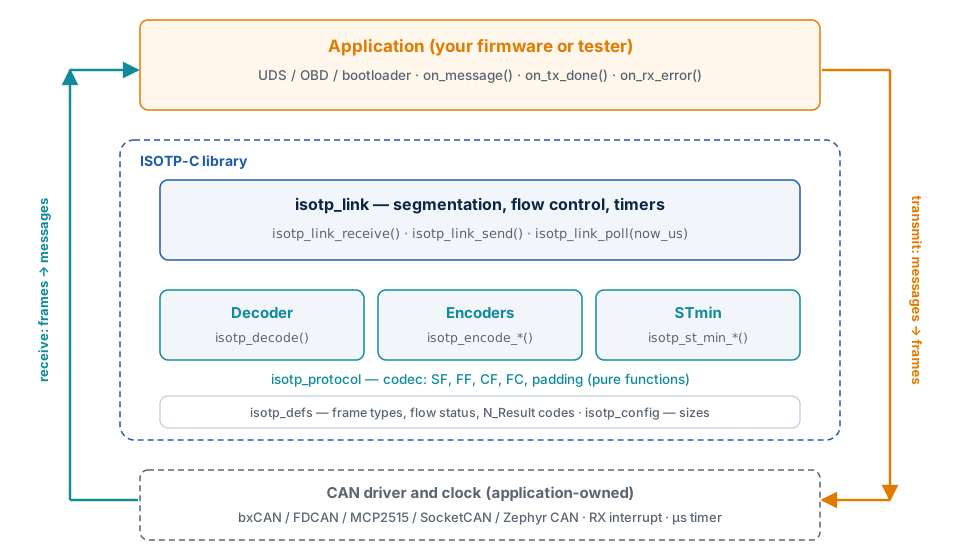
| Layer | Header | Responsibility |
|---|---|---|
| Definitions | isotp_defs.h |
Frame types, flow status values, frame layout limits, return and N_Result codes, big-endian helpers. No state. |
| Configuration | isotp_config.h |
Buffer sizes and protocol defaults, range-checked at compile time. |
| Codec | isotp_protocol.h |
isotp_decode() validates one CAN frame and describes it in a struct isotp_pdu; isotp_encode_*() write one frame; isotp_frame_pad(); STmin conversion. Pure functions over caller buffers. |
| Link | isotp_link.h |
One connection to one peer: copies outgoing messages, sends FF and CFs under the receiver's flow control, reassembles incoming messages, answers with Flow Control, runs the N_Bs and N_Cr timers, reports results. |
Each layer depends only on the ones below it. The codec can be used without the link, for example in a bus monitor that only decodes frames.
Data flow
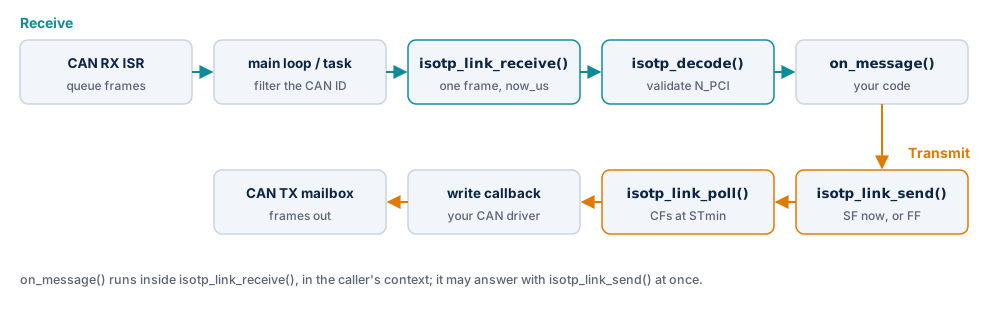
Receive path. Your CAN interrupt stores the frame; your task or main loop takes it
out, checks that its CAN ID belongs to this link and calls isotp_link_receive() with the
current time. The link decodes the frame and acts on it. A Single Frame is delivered to
on_message() straight from the frame data; the frames of a segmented message are copied
into the link's receive buffer, and on_message() is called when the last byte has
arrived. The link writes its Flow Control frames itself, through your write function.
Transmit path. isotp_link_send() sends a message of up to 7 bytes at once as a Single
Frame. A longer message is copied into the link's transmit buffer and its First Frame is
written; then the link waits for the receiver's Flow Control frame. Each call of
isotp_link_poll() sends at most one Consecutive Frame, when the separation time has
passed and the block is not finished. When the last frame has been written, the link
calls on_tx_done(ISOTP_N_OK).
Segmentation and flow control
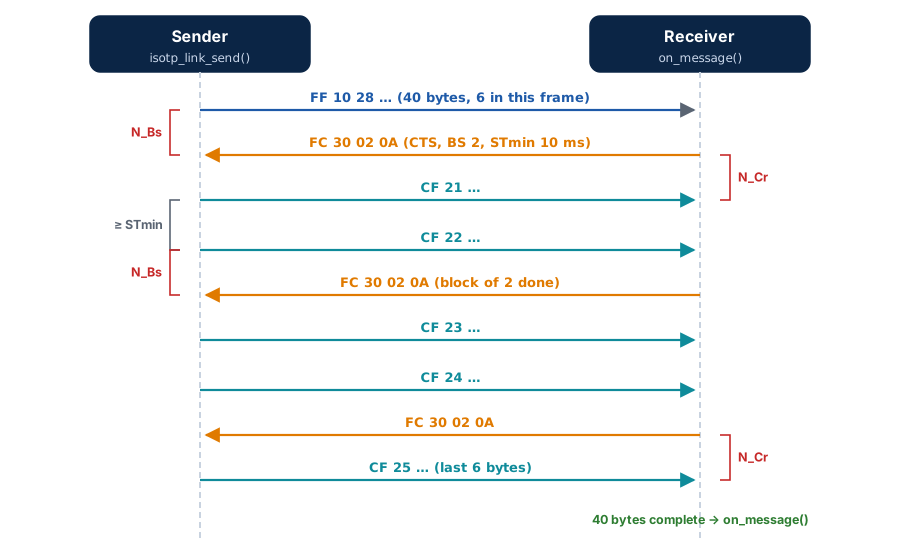
A message that does not fit a Single Frame is sent as a First Frame, which announces the total length and carries the first 6 bytes, followed by Consecutive Frames of up to 7 bytes with a 4-bit sequence number that starts at 1 and wraps from 15 to 0. After the First Frame and after every block of BS Consecutive Frames, the sender waits for a Flow Control frame from the receiver:
| Flow status | Sender |
|---|---|
| CTS (continue to send) | Sends the next block of BS frames (BS = 0: all remaining frames) with at least STmin between two frames |
| WAIT | Keeps waiting and restarts N_Bs; more than N_WFTmax Wait frames in a row end the transmission with ISOTP_N_WFT_OVRN |
| OVFLW (overflow) | Ends the transmission with ISOTP_N_BUFFER_OVFLW |
| other value | Ends the transmission with ISOTP_N_INVALID_FS |
The receiver answers a First Frame with CTS and its own BS and STmin
(isotp_link_config::block_size, ::st_min_us), and repeats the CTS after every BS
Consecutive Frames. It answers with OVFLW when the announced length does not fit
ISOTP_RX_BUFFER_SIZE. The library never sends WAIT: its receive buffer is always ready.
The receiver
- Decode.
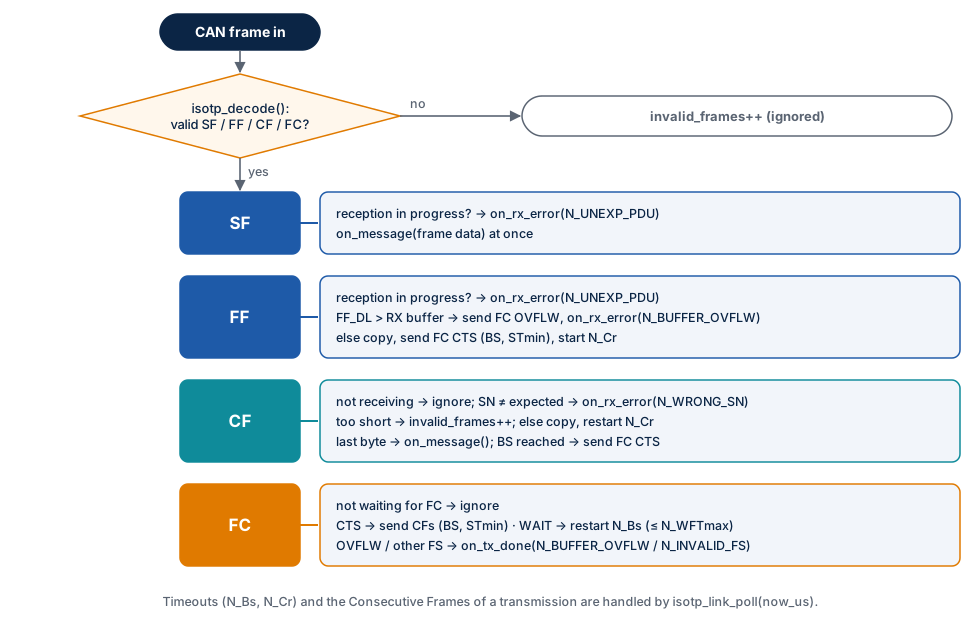
isotp_decode()rejects what ISO 15765-2 tells a receiver to ignore: a reserved frame type, SF_DL 0 or longer than the frame, a First Frame shorter than 8 bytes or announcing a message that would fit a Single Frame, an escape-sequence First Frame with a length up to 4095, a Consecutive Frame without data, a Flow Control frame shorter than 3 bytes. Rejected frames are counted (isotp_link_invalid_frames()). - Single or First Frame. If a reception is in progress, it ends with
on_rx_error(ISOTP_N_UNEXP_PDU)and the new frame is processed: a Single Frame is delivered at once, a First Frame starts a new reception. - Consecutive Frame. Ignored when no reception is in progress. A wrong sequence number
ends the reception with
ISOTP_N_WRONG_SN. A frame that carries fewer bytes than are still expected is counted as invalid and ignored. Otherwise its bytes are copied, N_Cr restarts, and the message is delivered when it is complete. - Flow Control frame. Handled by the transmitter when it waits for one (see above); ignored otherwise.
- Timeout.
isotp_link_poll()ends a reception withISOTP_N_TIMEOUT_CRwhen no Consecutive Frame arrived within N_Cr.
Recovery after errors
After any error the receiver is idle and accepts the next Single or First Frame. ISO-TP has no retransmission: the sender learns about a receiver error only by its own timeout (N_Bs) or by an Overflow, and the application (for example the UDS client) repeats the request.
The transmitter
| State | Entered when | Leaves on |
|---|---|---|
ISOTP_TX_IDLE |
init, end of a transmission | isotp_link_send() of more than 7 bytes |
ISOTP_TX_WAIT_FC |
First Frame written; block of BS frames written | FC CTS → SEND_CF; FC WAIT (≤ N_WFTmax) → stays; FC OVFLW, invalid FS, too many WAIT, N_Bs expired → IDLE with an error |
ISOTP_TX_SEND_CF |
FC CTS received | last frame written → IDLE (ISOTP_N_OK); block done → WAIT_FC; write error → IDLE (ISOTP_N_ERROR) |
When the write function returns ISOTP_BUSY for a Consecutive Frame, the link tries the
same frame again on the next poll. For a Single or First Frame, isotp_link_send()
returns the writer's result and nothing is started.
Time
The library never reads a clock. Every call that can start or check a timer takes
now_us, a free-running microsecond counter that may wrap at 2^32. Deadlines are stored
as now_us + timeout and compared modulo 2^32, which is correct as long as a timeout is
shorter than 2^31 µs (about 35 minutes); isotp_link_init() enforces that. The resolution
you get is the resolution of your counter and of your poll interval: to send at an STmin
of 1 ms, poll at least every millisecond.
Memory model
| Structure | Contents | Size with the default configuration (Cortex-M4) |
|---|---|---|
struct isotp_link |
configuration copy, both message buffers, both state machines, counters | 8 296 bytes |
struct isotp_link_config |
CAN ID, callbacks, flow-control and timing parameters | 48 bytes |
struct isotp_pdu |
one decoded frame (on the stack inside the link) | 16 bytes |
| Frame buffer | 8 bytes on the stack while one frame is written | 8 bytes |
There is no global state. Every link is independent; an application with three peers declares three links.
Error handling
| Situation | Result |
|---|---|
A NULL pointer, zero length or a value out of range |
ISOTP_ERROR; nothing is written or changed |
isotp_link_send() while a segmented transmission is in progress |
ISOTP_BUSY |
| The write function fails on a Single or First Frame | Its return value is returned by isotp_link_send() |
| The write function fails on a Consecutive Frame | ISOTP_BUSY: retried on the next poll; other: on_tx_done(ISOTP_N_ERROR) |
| The write function fails on a Flow Control frame | on_rx_error(ISOTP_N_ERROR); the reception ends |
| Malformed frame | Ignored, isotp_link_invalid_frames() + 1 |
| Protocol error or timeout | on_tx_done() / on_rx_error() with the N_Result code; also readable with isotp_link_tx_result() / isotp_link_rx_result() |
Threading and reentrancy
- Codec functions are reentrant: they only touch their arguments.
- A link is not thread-safe. Call
isotp_link_receive(),isotp_link_poll()andisotp_link_send()of one link from one context — a CAN task or the main loop, not the CAN interrupt — or protect all three with one mutex. - Callbacks run in the caller's context, inside
isotp_link_receive(),isotp_link_poll()orisotp_link_send(). They may callisotp_link_send()on the same link: the link updates its state before it calls them. - The message data passed to
on_message()is valid only during the call.
Design decisions
| Decision | Reason |
|---|---|
Time is an argument (now_us) |
No dependency on an OS or timer driver; tests control time exactly; works with any clock source. |
| One Consecutive Frame per poll | Bounded execution time per call; the CAN driver's queue is never flooded; STmin below the poll interval is still met because frames are never sent early. |
| The link copies outgoing messages | The caller may reuse its buffer at once; no lifetime rules for the payload. |
| Buffers sized at build time | No heap; the RAM per link is known at link time and in the map file. |
| STmin rounded up when encoded | The sender is never asked to go faster than the receiver needs. |
| Reserved STmin values read as 127 ms | Required by ISO 15765-2 for senders. |
| Single Frame delivered from the frame | No copy for the most common case (short requests). |
| Separate write and application contexts | The driver and the application layer are usually different modules. |
| Functional addressing only for Single Frames | ISO 15765-2 does not allow segmented messages to functional addresses. |