How It Works
This chapter explains the parts of the X430 emulator, the contexts it runs in, the states of a device, who owns which memory, how errors are reported and what may run in parallel. What a host sees, instruction by instruction, is in X430 Emulation.
Modules
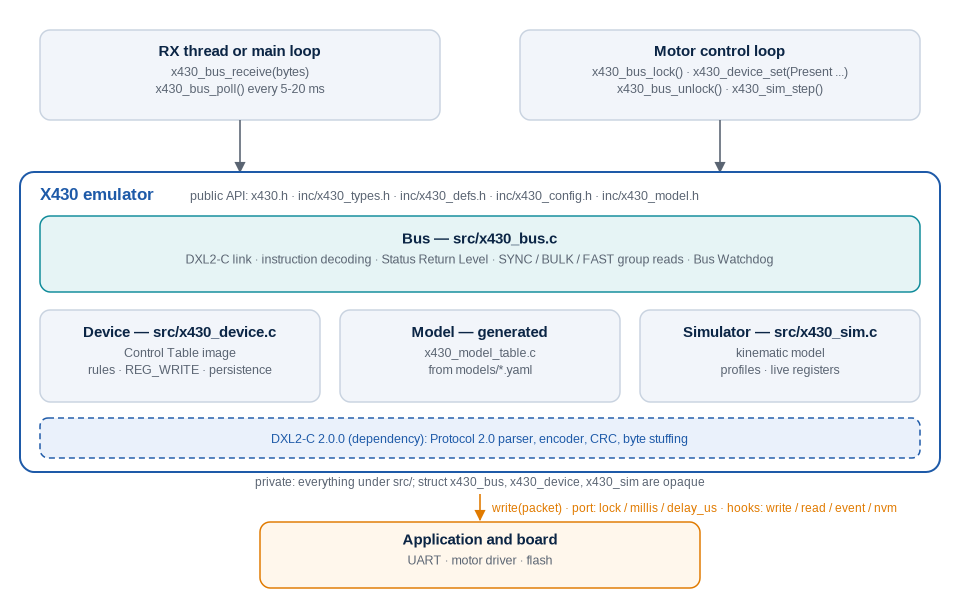
| Module | Files | Responsibility |
|---|---|---|
| Public API | x430.h, inc/x430_types.h, inc/x430_defs.h, inc/x430_config.h, inc/x430_model.h |
Functions, configuration types, hooks, status codes, Control Table addresses, build-time options, the model descriptor type |
| Bus | src/x430_bus.c |
DXL2-C link, addressing (ID, Secondary ID, broadcast), Status Return Level, Return Delay Time, single and group instructions, Fast read packets, Bus Watchdog timing, the bus lock |
| Device | src/x430_device.c |
Control Table image, write checks, write hook and storage, Indirect Address, REG_WRITE/ACTION, REBOOT, FACTORY_RESET, CLEAR, BACKUP, hardware errors, persistent blocks |
| Model | <build>/x430/generated/x430_model_table.c, x430_model_info.h |
The register list and address map of the selected model, written by tools/x430_gen_model.py from models/ |
| Simulator | src/x430_sim.c |
Kinematic model of the actuator behind a device (optional) |
| DXL2-C | dependency | Protocol 2.0 parser, encoder, CRC-16, byte stuffing |
Only the public API is visible to the application. Everything under src/ is private: the
instances struct x430_bus, struct x430_device and struct x430_sim are opaque blocks
of memory whose layout may change in any release.
Execution contexts
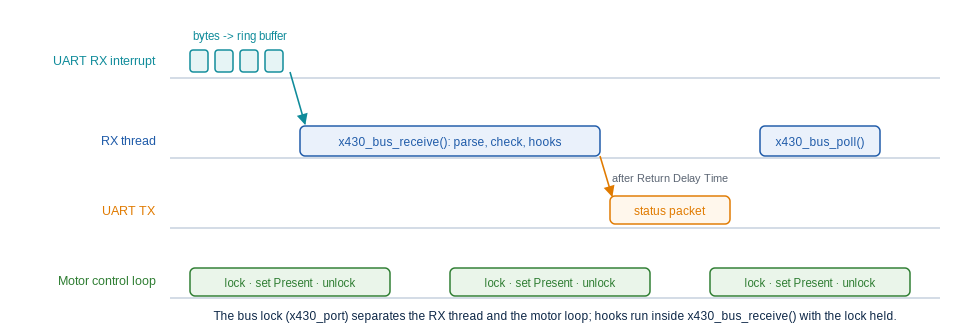
| Bus context | Motor context | |
|---|---|---|
| Functions | x430_bus_receive(), x430_bus_handle_packet(), x430_bus_poll() |
x430_bus_lock(), x430_device_set() / x430_device_get(), x430_bus_unlock(), x430_sim_step() |
| Context | One RX thread or the main loop, never an interrupt | The motor control loop (task or main loop) |
| Rate | As bytes arrive; x430_bus_poll() every 5–20 ms |
The rate of the control loop (for example 1 kHz) |
| Work | Parse, check, call the hooks, store, answer | Copy the motor state into the live registers |
| Time | Bounded by the packet: loops over its parameters, the touched registers, the devices of the bus | Bounded; x430_sim_step() is proportional to its elapsed_ms |
The two contexts share the Control Tables. The bus functions take the bus lock
(x430_port::lock) for the whole packet; the motor context takes the same lock around its
updates with x430_bus_lock(). On bare metal both run in the main loop and the port has
no lock.
Hooks run inside the bus context with the lock held. A hook may call the lock-free device
functions (x430_device_get(), x430_device_set(), x430_device_id(),
x430_device_raise_hardware_error()) but no bus function; to hand work to another thread,
post to an application queue from the hook.
States
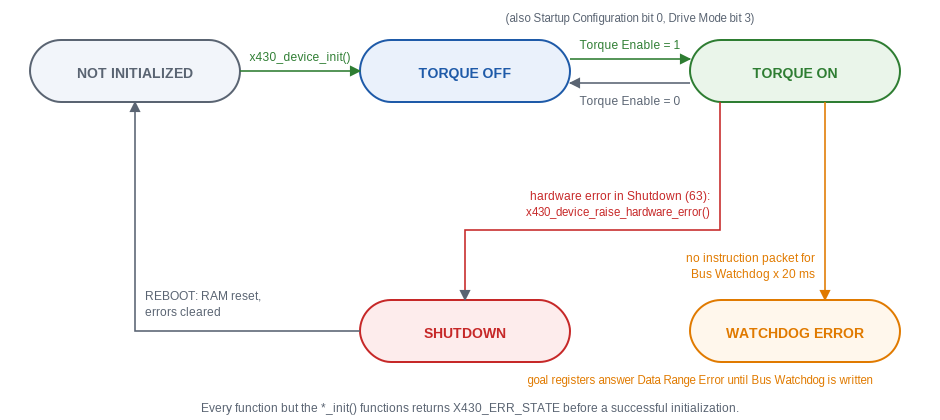
| State | Torque Enable (64) | Entered by | Left by |
|---|---|---|---|
| Not initialized | – | a zeroed or never initialized instance | x430_device_init() |
| Torque off | 0 | initialization, REBOOT, a write of 0, a shutdown | a write of 1, Startup Configuration bit 0, a goal write with Drive Mode bit 3 |
| Torque on | 1 | the transitions above; Goal Position takes Present Position | a write of 0, a hardware error in Shutdown (63) |
| Shutdown | 0, locked | x430_device_raise_hardware_error() with a bit enabled in Shutdown |
REBOOT (Hardware Error Status cleared) |
| Watchdog error | 1, Bus Watchdog reads −1 | no instruction packet for Bus Watchdog × 20 ms | a write of Bus Watchdog |
While a hardware error bit is set, every status packet carries the alert bit (0x80).
Memory model
| Object | Owner | Size on Cortex-M4 | Lifetime |
|---|---|---|---|
struct x430_bus |
Application (static, stack or pool) | 1,664 B (768-byte packets, the default), 640 B (256-byte packets) | From x430_bus_init() |
struct x430_device |
Application | 384 B (with every feature and without) | From x430_device_init() |
struct x430_sim |
Application | 32 B | From x430_sim_init() |
| Configurations | Application; copied by the *_init() functions | – | Only during the call |
Hooks (struct x430_hooks), port (struct x430_port) |
Application | – | As long as the device or bus (the library keeps a pointer) |
| Model table | Library (const, flash) |
921 B | Static |
A device holds the compact image of its Control Table (316 bytes: the 662 addresses
without their long reserved runs, theory) and the
REG_WRITE data (X430_REG_WRITE_SIZE); it keeps no copy of a persistent block, the hooks
read and write blocks in parts. A bus holds the DXL2-C link (receive buffer and decoded
packet) and one packet buffer in which it builds and byte-stuffs every status packet, Fast
Sync/Bulk Read answers included. There is no heap, no global or static
mutable variable and no hidden buffer: the sizes are fixed at compile time by
X430_BUS_WORDS, X430_DEVICE_WORDS and X430_SIM_WORDS (plain arithmetic of the
configuration macros, which static analysis can evaluate) and checked against the private
state by _Static_assert.
Error handling
| Situation | Result |
|---|---|
NULL instance or argument |
X430_ERR_PARAM; nothing is changed |
| A device ID above 252, a bus without writer | x430_device_init() / x430_bus_init() return X430_ERR_PARAM; the instance is not changed |
| Any call before a successful initialization | X430_ERR_STATE; no hook is called |
| Attaching a device twice | X430_ERR_STATE |
| Bus full, ID already used on the bus | X430_ERR_CONFIG |
| The byte writer returns non-zero | x430_bus_receive() / x430_bus_handle_packet() return X430_ERR_HAL (once) |
| A feature that is not compiled in | X430_ERR_UNSUPPORTED (x430_device_backup(), x430_sim_*()) |
| An instruction the device refuses | X430_OK; the protocol error (DXL2_ERR_*) goes into the status packet and into the error output |
| Malformed packet (CRC, length) | Dropped by DXL2-C; no answer, as a real device |
Instruction semantics never fail at the API level: an invalid address, length or value is a protocol error for the host, not an error of the application.
Threading and reentrancy
- Per bus: one bus context; the bus functions are not reentrant for the same bus.
- Live register updates from another context go between
x430_bus_lock()andx430_bus_unlock(); the lock must be recursive if a hook can lead to code that takes it again. - Different buses share nothing and may run in parallel.
- Hooks run in the context of the bus function that calls them.
Design decisions
| Decision | Reason |
|---|---|
| One model per build, generated tables | The Control Table is data (YAML checked against the e-Manual), not code; a build carries only the table it needs. |
| Library = table and protocol, motor = application | The same library serves steppers, BLDC drives and the simulator; motion control has no place in a protocol emulator. |
| Two passes for a write: check every register, then hook and store | A multi-register write is all or nothing for the checks, as on the real actuator. |
| Hooks receive real addresses | Indirect Data is resolved by the library; the application needs one write path. |
Status codes for API misuse, DXL2_ERR_* for the host |
Errors of the application and errors of the host never mix. |
| Persistent blocks with header and CRC | A block from another model, format or a damaged flash page is ignored; the device starts with factory values. |
| Opaque instances | The application cannot depend on internal fields (MISRA deviation DEV-01). |
X430_ERR_STATE before initialization |
A zeroed or garbage instance never calls a NULL hook. |