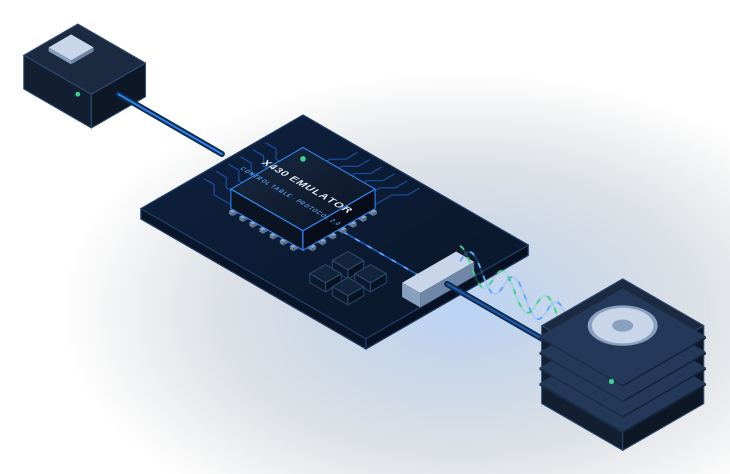
Your own actuator, the DYNAMIXEL tools you already use
A robot arm built around a stepper or a BLDC driver needs a host protocol. Writing one means a host driver, a ROS 2 plugin and a configuration tool of your own. Answering as a DYNAMIXEL X430 instead gives you DynamixelSDK, DYNAMIXEL Wizard and dynamixel_hardware_interface — if the device behaves like an X430 down to the rules of its Control Table, inside the RAM and flash of a small MCU.
Behaves like the X430
All 17 X430 models with Control Tables generated from YAML and checked against the e-Manual; every instruction a host uses, Indirect Address, Bus Watchdog, shutdown, backup. 52 checks with the official DynamixelSDK pass end to end.
Tight embedded budgets
384 B of RAM per device and 1,664 B per bus on Cortex-M4, 10,119 B of flash at -Os including the model table; no allocation, no globals, no OS.
Built for review and certification
Zero MISRA C:2012 violations, a documented deviation register, 100 % line and branch coverage, bounded execution time and static analysis in CI.
One library from the serial bytes to your motor
24 public functions in three parts — the bus that decodes the line, the devices that hold the Control Tables, and an optional simulator — one model per build, optional instructions selected with Kconfig or plain definitions.
The X430 Control Table
Access rights, ranges and limit registers, EEPROM lock, REG_WRITE/ACTION, Secondary ID, Status Return Level, Return Delay Time.
Group and Fast reads
SYNC, BULK, FAST_SYNC and FAST_BULK reads and writes, as ROS 2 uses them with Indirect Address.
Any motor
One byte writer, an optional port (lock, clock, delay) and five hooks per device connect it to your firmware.
The safety rules of the actuator
Hardware error shutdown, Bus Watchdog, goal synchronization on torque on, and a persistent EEPROM area with CRC.
Complete documentation
Guides, the theory with measured results, the integration guide and a full API reference, also as a PDF.
Quality gates in CI
Unit tests (and model-based tests) with a 100 % coverage gate, MISRA C:2012 gate, Cppcheck and CodeQL.
Quick start
One joint on one serial line
The application gives the bus a byte writer and feeds it the received bytes; the device calls a hook for every accepted register write, and the motor loop keeps the live registers current. Everything runs in the main loop (or one RX thread).
#include "x430.h"

static struct x430_bus bus;
static struct x430_device joint;

static int uart_write(void* context, const uint8_t* data, size_t length)
{
    (void)context;
    return board_uart_write(data, length); /* 0 on success */
}

static uint8_t on_write(struct x430_device* device, uint16_t address, uint8_t size,
                        int32_t value, void* user_data)
{
    uint8_t result = DXL2_ERR_NONE;

    (void)device;
    (void)size;
    (void)user_data;
    if (address == X430_ADDR_TORQUE_ENABLE)
    {
        if (!motor_enable(value != 0))
        {
            result = DXL2_ERR_RESULT_FAIL; /* the host sees Result Fail */
        }
    }
    else if (address == X430_ADDR_GOAL_POSITION)
    {
        motor_move_to(value);
    }
    else
    {
        /* other registers are only stored */
    }
    return result;
}

static const struct x430_hooks hooks = {.write = on_write};

int main(void)
{
    const struct x430_bus_config bus_config = {.write = uart_write};
    const struct x430_device_config joint_config = {.id = 1U, .hooks = &hooks};

    board_init();
    if ((x430_bus_init(&bus, &bus_config) != X430_OK) ||
        (x430_device_init(&joint, &joint_config) != X430_OK) ||
        (x430_bus_attach(&bus, &joint) != X430_OK))
    {
        for (;;)
        {
        }
    }
    for (;;)
    {
        uint8_t bytes[64];
        const size_t count = board_uart_read(bytes, sizeof(bytes));

        (void)x430_bus_receive(&bus, bytes, count); /* parse, check, hooks, answer */
        if (board_tick_1ms())
        {
            (void)x430_bus_lock(&bus); /* live values from the motor */
            (void)x430_device_set(&joint, X430_ADDR_PRESENT_POSITION, motor_position());
            (void)x430_device_set(&joint, X430_ADDR_MOVING, motor_moving() ? 1 : 0);
            (void)x430_bus_unlock(&bus);
            (void)x430_bus_poll(&bus); /* Bus Watchdog */
        }
    }
}
The board_… and motor_… functions stand for your UART and motor code; the
Integration Guide shows the RTOS layout, persistent storage and the
port (lock, clock, delay).
Find your way
| If you want to… | Read |
|---|---|
| Understand what the library does and does not do | Introduction |
| Build it, run the tests, add it to your project | Getting Started |
| Understand the modules, contexts, states and memory | How It Works |
| Set up devices and react to the host | Using the Library |
| Know exactly what an X430 host sees | X430 Emulation |
| Choose the model and the build options | Configuration |
| Connect it to a UART, an RTOS and flash | Integration Guide |
| Look up a function | API Reference |
| Read everything offline or print it | PDF user manual |
 SystemFromScratch®
Part of an open-source embedded portfolio
The X430 emulator is developed by Anton Vynohradov under SystemFromScratch® — secure embedded systems and compliance-ready engineering, from concept to certification-ready product.
SystemFromScratch® is a registered trademark. DYNAMIXEL and ROBOTIS are trademarks of ROBOTIS Co., Ltd.; this independent implementation is not affiliated with or endorsed by ROBOTIS.